Humayun Aziz Sandeela
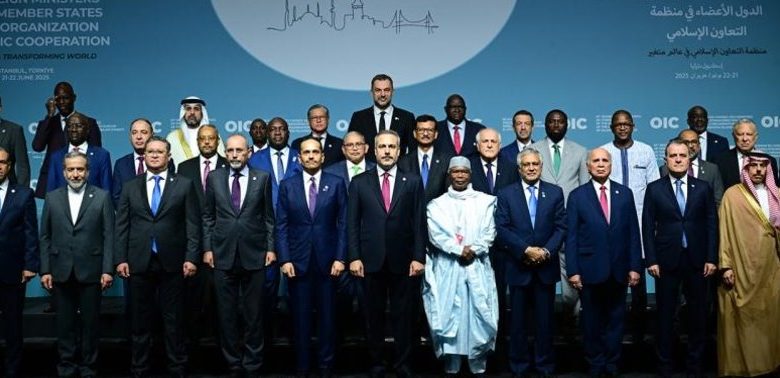
 The Organization of Islamic Cooperation (OIC), comprising 57 member states and representing over 1.8 billion Muslims worldwide, has once again reaffirmed its steadfast support for the people of Indian Illegally Occupied Jammu and Kashmir. At its 51st Council of Foreign Ministers, held in Istanbul on 21–22 June 2025, the OIC adopted a declaration renewing solidarity with the Kashmiri people and expressing full support for their inalienable right to self-determination in accordance with relevant UN Security Council and OIC resolutions. The declaration also condemned the grave and systematic human rights violations committed by Indian forces in the occupied territory, sending a clear message that the cause of Kashmir remains a central concern for the Muslim world.
“Self-determination is not a privilege—it is a principle enshrined in international law.”
This is not a newfound position, but the continuation of a decades-long commitment rooted in principles of justice, international law, and the collective conscience of the Muslim ummah. Since its inception in 1969, the OIC has persistently raised its voice for Kashmir, calling for the resolution of the dispute in accordance with the wishes of its people and the resolutions passed by the United Nations Security Council. In 1994, the organization took a decisive step by establishing the OIC Contact Group on Jammu and Kashmir, which has played an instrumental role in maintaining diplomatic pressure and articulating the moral and political responsibility of the international community toward the Kashmiri people.
Throughout the years, the OIC has issued numerous resolutions condemning India’s military occupation and its brutal policies in the region. These include declarations passed in the early 1990s during the height of armed resistance in Kashmir, the 2005 Makkah Extraordinary Summit where the issue of Kashmir was explicitly reaffirmed as a priority, and the 2019 statements following India’s unilateral revocation of Articles 370 and 35A—actions that violated international law and the special status previously granted to the region under India’s own constitution. In 2021, during the Niger CFM session, the OIC went further by denouncing India’s demographic changes in Kashmir and calling for the reversal of all illegal measures implemented since 5 August 2019.
In Istanbul this year, the message was no different—but it was louder and more urgent. The declaration underscored the ongoing suffering of the Kashmiri people and the systematic attempt by Indian authorities to change the demography of the region through forced settlements, coercive legal changes, and suppression of civil liberties. It recognized that the right to self-determination is not merely a political slogan but a binding principle enshrined in international law.
“India cannot rewrite international law by revoking Article 370—it can only expose its defiance of it.”
Indeed, the right to self-determination is one of the foundational principles of the United Nations Charter, affirmed in Article 1.2, and codified in the International Covenants on Civil and Political Rights and Economic, Social and Cultural Rights—treaties that bind all UN member states.
Moreover, the legal framework for the resolution of the Kashmir dispute already exists. The United Nations Security Council has passed several resolutions, including Resolutions 47 (1948), 91 (1951), and 122 (1957), which call for a free and impartial plebiscite under UN supervision to allow the people of Jammu and Kashmir to determine their own political future. India’s refusal to honor these commitments is not only a betrayal of the Kashmiri people but a violation of international law.
What makes the situation even more dire is India’s blatant disregard for the Geneva Conventions, particularly the Fourth Geneva Convention of 1949, which governs the conduct of occupying powers in conflict zones. The convention prohibits demographic alterations, the transfer of civilian populations into occupied territory, arbitrary detention, torture, collective punishment, and restrictions on religious freedoms—all of which are documented and ongoing in IIOJK.
“Demographic engineering in Kashmir is not just policy—it is a war crime under the Geneva Conventions.”
Since August 2019, Kashmir has become one of the most heavily militarized and surveilled regions in the world. More than 900,000 Indian troops operate in the territory. Human rights organizations, including Amnesty International and the UN High Commissioner for Human Rights, have reported widespread abuses, including the use of pellet guns that have blinded hundreds of protestors, mass graves, enforced disappearances, and systemic torture.
- Arbitrary detention of political leaders, journalists, and minors
- Revocation of special status and implementation of domicile laws to alter demographics
- Frequent communication blackouts and internet shutdowns
- Suppression of religious gatherings and closure of mosques
- Silencing of dissent through draconian laws like the Public Safety Act and UAPA
These acts are not isolated violations—they constitute a coherent strategy of repression, aimed at crushing Kashmiri identity and dismantling the cultural, political, and demographic fabric of the region. The OIC, recognizing the seriousness of these developments, has repeatedly demanded that India allow international human rights organizations, UN observers, and OIC delegations access to the region—a demand that continues to be rejected by New Delhi.
“Kashmir is not a domestic matter—it is a human tragedy unfolding in plain sight.”
But while the OIC’s moral stance has remained consistent, its critics often argue that its influence has not translated into tangible action. For the Kashmir cause to truly benefit from OIC backing, diplomatic statements must now evolve into a proactive strategy. The OIC can play a more effective role by mobilizing its member states to take the issue to forums like the UN Human Rights Council in Geneva, support cases in the International Court of Justice, or even back investigations by the International Criminal Court into war crimes in Kashmir. The organization could consider the establishment of a permanent OIC human rights mission focused on IIOJK and support the creation of a comprehensive legal dossier documenting Indian violations for submission to global judicial bodies.
“Declarations must now become action—the time for passive solidarity has passed.”
The Istanbul Declaration must not be remembered as just another symbolic gesture. It must mark a turning point where solidarity is fortified with strategy. Kashmir is not merely a territorial dispute—it is a human tragedy unfolding in slow motion. For over 76 years, a people have been denied their voice, their rights, and their dignity.
As India continues to project an image of normalcy while locking down an entire population, the OIC must stand firmer than ever, not just in words, but in action.
In the end, the question is not whether the OIC supports Kashmir. That has been answered countless times, most recently and eloquently in Istanbul. The real question is how far it is willing to go in the service of that support.
Because for every silence from the world, a generation is sentenced to live in darkness. The time for passive declarations is over. The time for principled international resistance has arrived. The people of Kashmir deserve nothing less.